Poiteau Botaniste
Our story
A portrait, a man, a family, and the path that led to the present day.
Select a step to read more.

Portrait de Pierre-Antoine POITEAU, peint par Pierre VERDEIL (1854)
For a long time, this portrait was simply part of the decor in my grandparents’ house. As a child, it intimidated me.
A man in formal attire, depicted with a few books behind him. I knew he was an ancestor on the Poiteau side, a botanist in the family, but his story remained largely unknown to me.
Then, after my grandparents passed away, I took charge of this portrait.
As I looked at it with fresh eyes, certain details began to intrigue me: the books arranged behind him, the titles one could make out, and above all, the question that forced itself upon me:
Who was this man, really?
That question is where it all began.
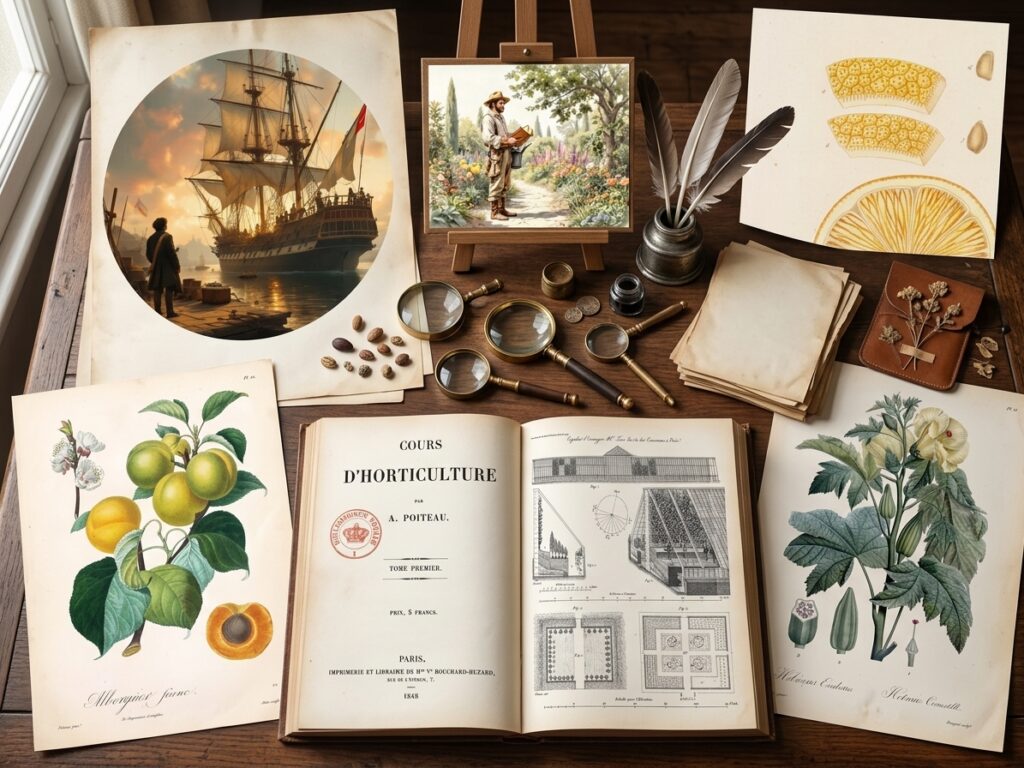
My initial research quickly went beyond what I had imagined.
Pierre-Antoine Poiteau was not simply a botanist who left behind a few works.
Born in 1766 into a modest family, he followed an astonishing path that gradually led him to horticulture, the Jardin des Plantes, and the scientific institutions of his time.
He became a gardener, botanist, horticulturist, illustrator, explorer, and author.
He took part in expeditions to distant lands, notably to Santo Domingo and then to French Guiana; he worked on the distribution and acclimatization of plants; he collaborated with leading botanists and illustrators of his time; and he contributed to works that are now part of the history of botany and pomology.
The more I learned about Poiteau, the more I realized that the family portrait concealed a much broader story.
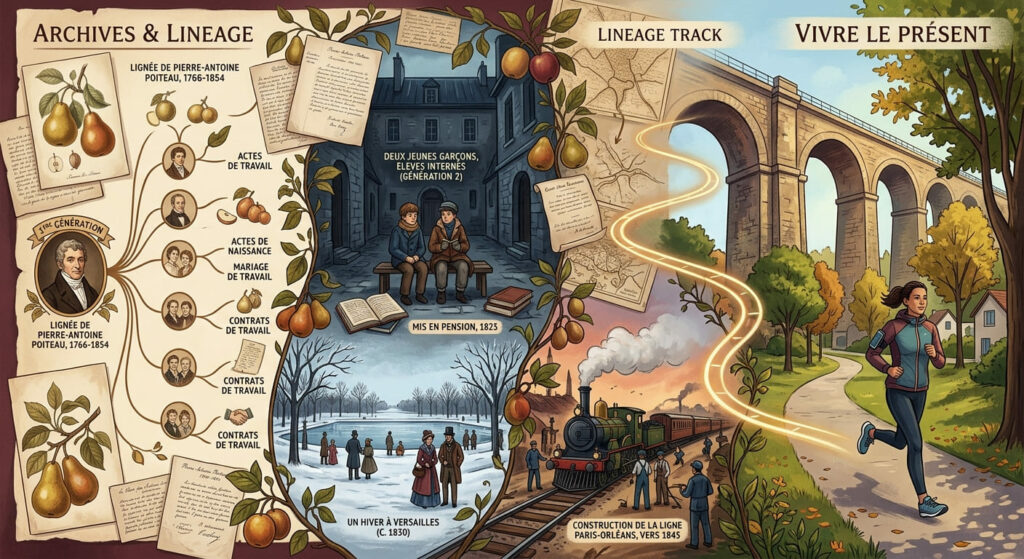
Genealogical research is gradually confirming the connection between Pierre-Antoine Poiteau and my family.
But as I trace the family tree back, I’m discovering above all that behind the names and dates lie very real stories.
Poiteau’s first two children, for example, remained in France while their father went overseas. They were sent to boarding school, at the expense of the government of the time.
One of them even nearly drowned in the winter in a pond at Versailles. He owed his life to the intervention of a friend.
Later, another of his sons helped build the Paris–Orléans railroad line.
And this family history takes on a surprisingly contemporary dimension: that old line is now part of the rail network that I use to get to Paris. When I go for a run, I regularly pass under a viaduct connected to that infrastructure.
Two centuries after Poiteau, traces of his family history still cross paths with my daily life.
Pierre-Antoine Poiteau · Antoine Alexandre Albert Poiteau · Armand Camille Poiteau · Lucien Armand Poiteau · My grandfather · My mother · Me
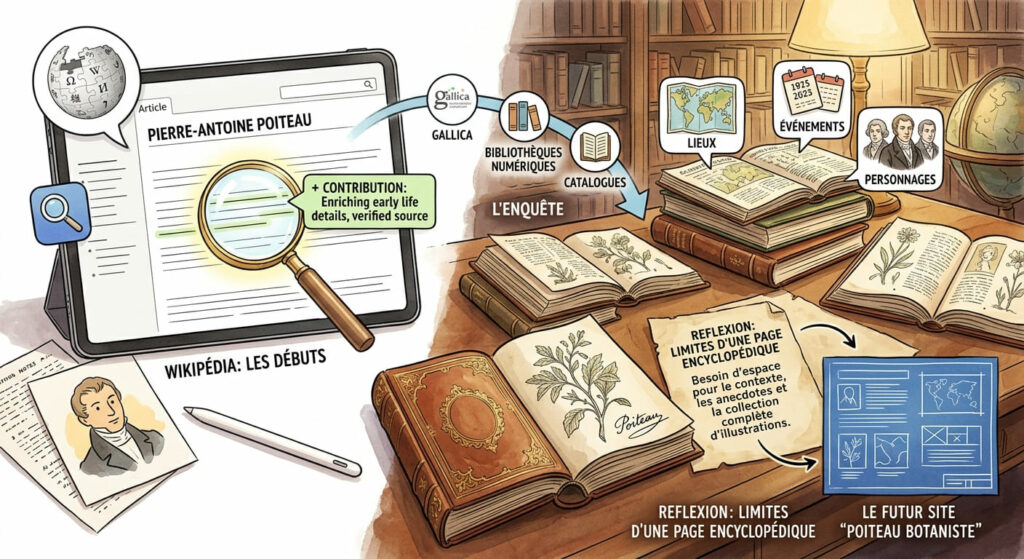
At first, Wikipedia is naturally one of the first places to start.
But my research quickly takes me much further: Gallica, digital libraries, catalogs, digitized historical works, scientific and horticultural publications…
I cross-check the information and look up the sources, people, places, and events mentioned in his life.
Some discoveries even help enrich the Wikipedia page dedicated to Poiteau.
But the more I look, the more I run up against a limit.
An encyclopedia entry must provide a summary.
It isn’t designed to recount every anecdote, elaborate on historical contexts, showcase various works, or create a dialogue between a biography and a collection of illustrations.
Above all, the information I was uncovering was scattered across numerous sources.
It became necessary to create a space where I could bring it all together and present it in a different way.
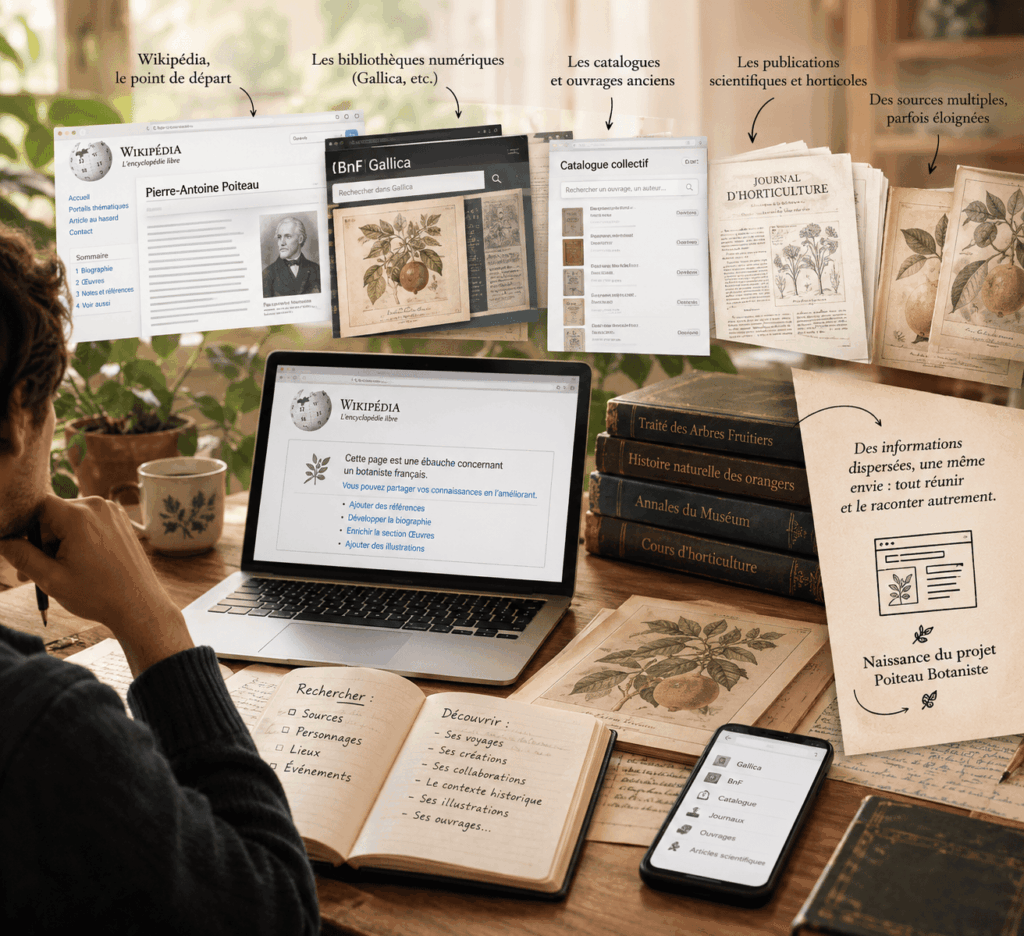
In February 2025, I launched Poiteau Botaniste.
The goal is not to replace existing sources, but to create a complementary space: a place where we can take the time to tell stories.
Poiteau’s life, his travels, his encounters, his works, his collaborators, his anecdotes, and his illustrations can finally be brought together in a single universe.
The portal also allows me to share stories that the encyclopedic format doesn’t always allow for: an anecdote, a travel story, a person, a discovery made while browsing through an archive, or even the context in which a work was created.
My family research had become a project of passing on knowledge.
I am neither a historian nor a botanist. I am a descendant who searches, verifies, and shares what I discover.
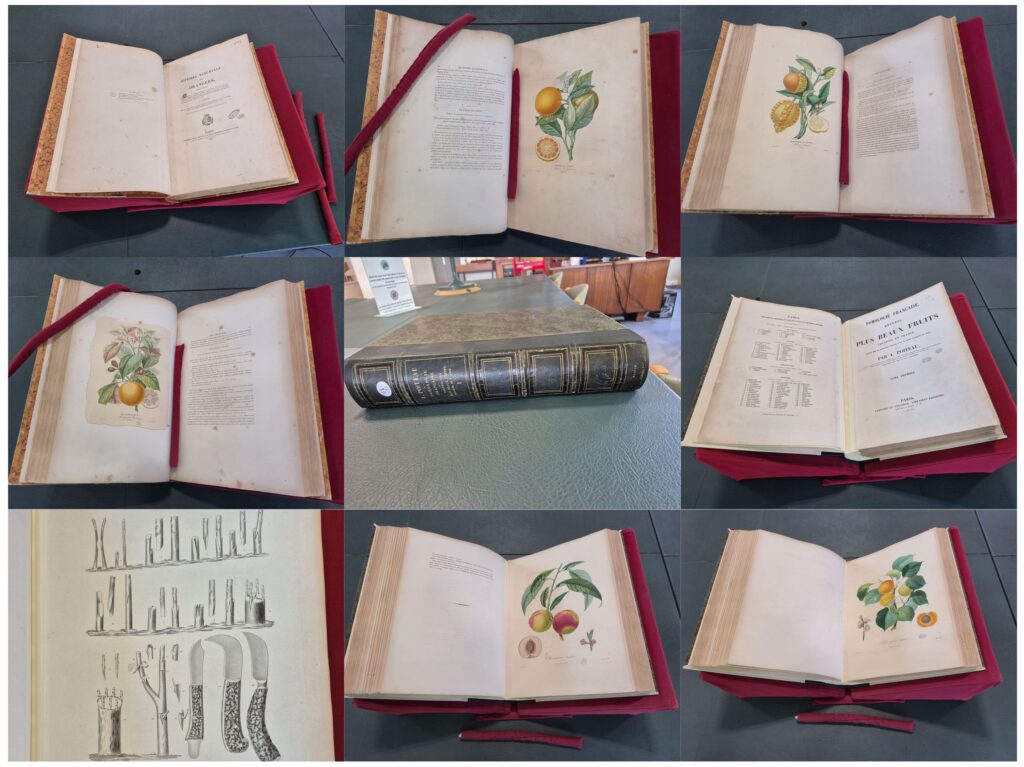
Photos des ouvrages Histoire Naturelle des Orangers et Pomologie Française
Through my research, I had discovered digital versions of Poiteau’s works.
But I wanted to see them in person.
I went to the Library of the National Museum of Natural History in Paris to consult, in particular, two major works: Histoire naturelle des Orangers and Pomologie française.
Holding these volumes in my hands, turning their pages, and viewing the plates in their original context changes the way one looks at these works.
We no longer see just a digitized image.
We discover the interplay between the scientific description, the composition of the plate, the paper, the printing, the colors, and the meticulous work of the authors and illustrators.
Botany also becomes part of our visual heritage.
Les recherches et consultations portent notamment sur Histoire naturelle des Orangers. À ce jour, je ne dispose pas des droits nécessaires pour exploiter ses illustrations sur la boutique. En revanche, j’ai trouvé des versions numériques de grande qualité du Traité des arbres fruitiers, dont les planches anciennes sont dans le domaine public.
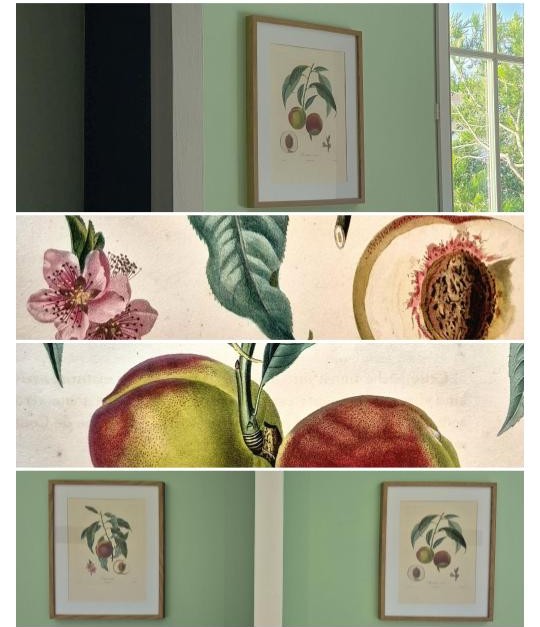
At the end of May 2025, a few weeks after my visit to the museum, I had the opportunity to acquire two original illustrations from the ‘Traité des arbres fruitiers‘:
The “Vineuse Hâtive” peach, painted by Pierre Jean François Turpin, and the “Chevreuse tardive” peach, painted by Pierre-Antoine Poiteau.
Seeing them in an old book was fascinating enough.
Having them right in front of me, on my own walls, was something else entirely.
The more I looked at them, the more I began to see the delicacy of the drawing, the colors, the details, the composition, and the care taken in depicting the fruit in a new light.
It was truly by living with these works that I came to appreciate their beauty.
Peach « Vineuse Hâtive » (Pierre Jean François Turpin) and Peach « Chevreuse tardive » (Pierre-Antoine Poiteau) – Traité des arbres fruitiers
This experience sparked a new desire:
What if other people could also discover these illustrations in a way other than in an old book or on a screen?
So I continued my search to find high-quality digital versions of the works that were in the public domain.
In particular, ‘Traité des arbres fruitiers‘ allowed me to work with high-definition scans.
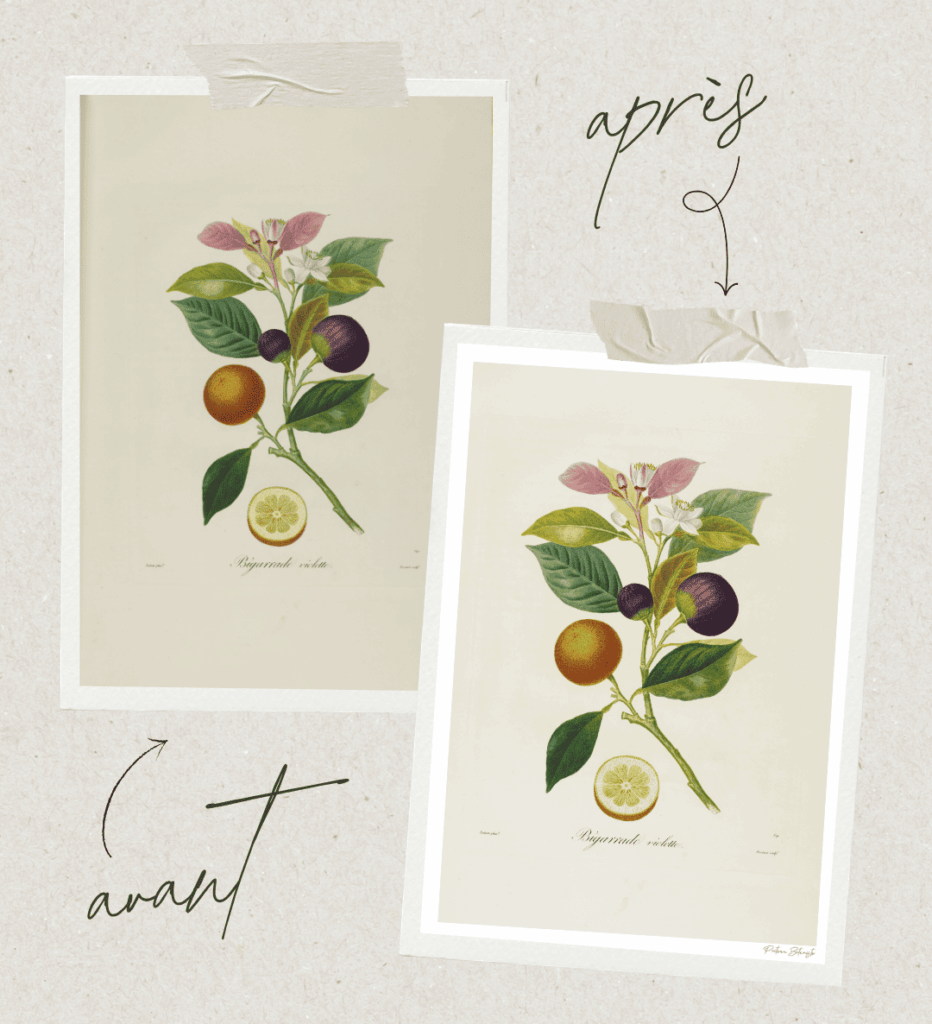
However, some plates require significant work before they can be reproduced: creases in the pages, binding marks, scanning defects, variations in lighting, or other imperfections.
I have begun restoring these images one by one.
About sixty plates have already been restored out of the more than 400 plates in the book.
In October 2025, the Poiteau Botaniste store opened its doors.
Its goal is not simply to sell posters.
The aim is to bring Poiteau’s illustrations to life in a new way and to allow everyone to discover their beauty, their history, and their origins.